We are pleased to announce that the 23rd biennial conference of SASMARS was held at Mont Fleur in Stellenbosch, South Africa on 26 – 28th August 2016.
“Texts and Transformations: Medieval and Early Modern Cultures”
Medieval and Early Modern societies weathered various socio-cultural transformations, ranging from economic developments to religious conflicts, across a range of different geographies and in urban and rural spaces. How did poetry, theatre, prose, visual art, architecture, and other forms of art respond to such changes? How do we historically understand and assess various kinds of social transitions?
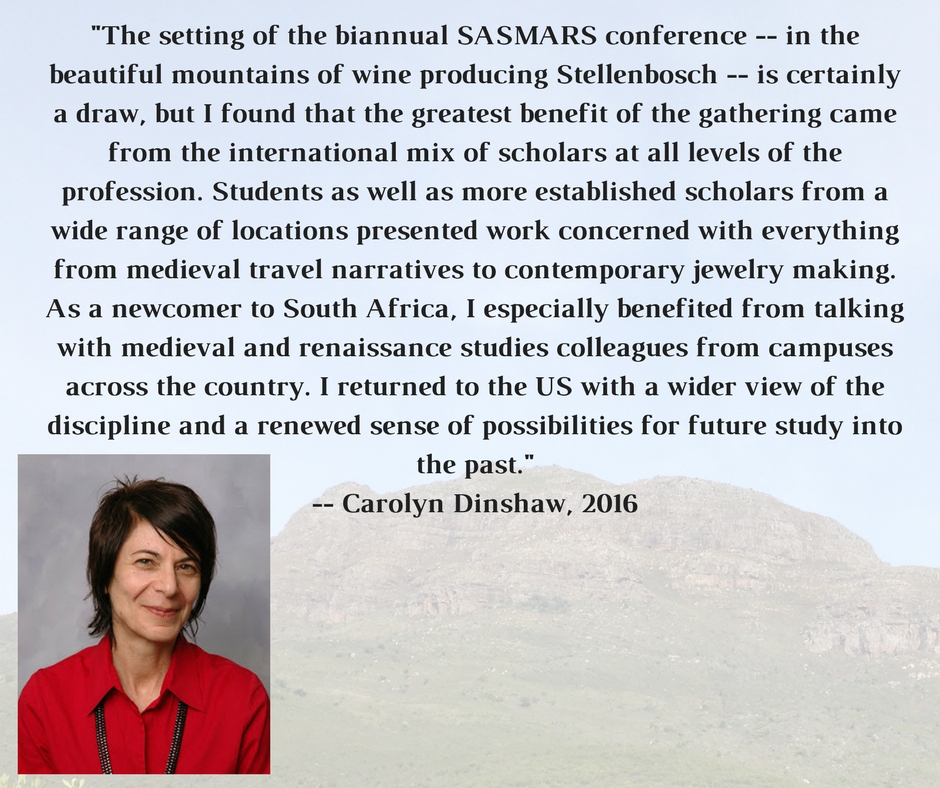
At this year’s SASMARS conference, Professor Carolyn Dinshaw (New York University), an acclaimed medievalist, was our keynote speaker, and she delivered the following keynote to the conference attendees:
“Black Skin, Green Masks: Medieval Foliate Heads, Racial Trauma, and Queer Worldmaking”.
Carolyn Dinshaw has been interested in the relationship between past and present ever since she began to study medieval literature. Her 1982 dissertation, subsequently published as Chaucer and the Text in 1988, explored the relevance of new critical modes for older literature, while in her 1989 book, Chaucer’s Sexual Poetics, she investigated the connection of past and present via the Western discursive tradition of gender. In Getting Medieval: Sexualities and Communities, Pre- and Postmodern (1999), she traced a queer desire for history. In her most recent book, How Soon is Now? Medieval Texts, Amateur Readers, and the Queerness of Time (2012), she looks directly at the experience of time itself, as it is represented in medieval works and as it is experienced in readers of those works. In the classroom, she regularly teaches materials past and present, in courses ranging from Medieval Misogyny to Queer New York City.
Dinshaw’s current research projects extend her interests into the visual field. It’s Not Easy Being Green focuses on the eerie figure of the foliate head – a decorative motif well nigh ubiquitous in medieval church sculpture in Western Europe that became known in the 20th century as the Green Man. This imagined mixture of human and vegetable (a head sprouting leaves or made up of vegetation) is the point of departure for her research on human/non-human relations, queerness and queer sexual subcultures now, “the ecological thought” (as Timothy Morton puts it), and what medieval literature can tell us about it all.
The second project, Exploring Nowhere: Mirages, Digital Maps, and the Historical Problem of Location, is undertaken with visual artist Marget Long. It is a project that explores paradoxical places where time and space operate differently from all other places on earth – “nowheres that are somewhere” (to adapt Alessandro Scafi’s resonant phrase for medieval representations of Paradise). Long and Dinshaw look to the optical phenomenon of the mirage—a strange and elusive “nowhere”—to explore the broad concepts of location and locatability. They investigate the mirage’s visual and cultural history through a wide array of materials: medieval maps and legends of Paradise (which was in at least one instance thought to be a mirage), early 20th-century Arctic exploration, and photographs and video works from Long’s project on mirages.
 SASMARS